
Liberty County Parole and Probation
Florida uses community supervision as an umbrella term, but the labels beneath it are not interchangeable. Probation is imposed by a court as a sentence or as part of one. Parole is discretionary release under Florida's older parole framework and now applies to a narrow group of eligible sentences. Conditional release is a statutory form of post-prison supervision for qualifying people. Community control is a more intensive court-ordered status. None means the person remains housed in Liberty County Jail.
The agency roles also differ. The Florida Commission on Offender Review makes parole, conditional-release, conditional-medical-release, and certain revocation decisions. Florida Department of Corrections field staff supervise people in the community. Liberty County court records remain central for probation because they contain the judgment, conditions, modifications, violation filings, revocation, and termination order.
| Status | Who creates it | Best verification record |
|---|---|---|
| Probation | Sentencing court | FDC Supervised Population detail plus the court case |
| Parole | Florida Commission on Offender Review | Signed Commission action plus the FDC supervision detail |
| Conditional release | Statutory program administered by FCOR | FCOR order and active FDC supervised record |
| Community control | Sentencing court | Court order and FDC supervised record |
- Discharge
- Formal completion or termination of supervision.
- Absconder
- A person who has stopped making himself or herself available to supervision.
- PPRD
- A presumptive parole release date, not a guaranteed release date.
- EPRD
- An effective parole release date set later in the parole process.
Check Liberty County Post-Release Supervision
The FDC Supervised Population Information Search is the primary public lookup for a named person. Use the six-character DC number when it is known. A name search can find more than one person, so identity must be checked against birth date, offense and case details. FDC says most supervised-population data refreshes weekly, while termination dates and location changes update nightly.
- Open the Supervised Population search, not the current prison population form.
- Enter the DC number, or search by first and last name. Review aliases if the record provides them.
- Open the matching detail and compare identifying data, supervision type, offense, court case, start date, termination date, current status, and current location.
- Use the listed location or supervising office as the routing clue. Confirm that assignment before traveling to an office.
- For probation, read the Liberty Clerk docket for the sentence and any later modification, violation, revocation, or termination.
- For parole or conditional release, obtain the controlling FCOR action when the public schedule does not establish the outcome.
A completed FDC prison release and an active supervised-population result can both be correct. The first closes a prison custody episode. The second shows that community supervision continues. For a Liberty County jail-only case, an FDC no-result does not settle the question because the case may require a court record or direct office confirmation.
Important: A past termination date should be checked against the latest detail and the signed discharge or court order before treating supervision as complete.
Liberty County Supervision Office Routing
FDC's official Circuit 2 office page expressly includes Liberty County with Franklin, Gadsden, Jefferson, Leon, and Wakulla Counties. It lists the Tallahassee Circuit Office at a Monticello address. The page does not list a Bristol adult probation field office. That difference matters because a circuit contact is not proof that every Liberty County supervisee reports at that building.
FDC Tallahassee Circuit Office
1455 South Jefferson Street
Monticello, FL 32344
(850) 342-0272
Fax: (850) 342-0274
tallahassee.cir@fdc.myflorida.com
FDC Field Services Search Help
(850) 717-3444
co-supervision@fdc.myflorida.com
Use for questions about the public supervised-population record and current office routing.
The individual FDC detail is the better starting point for reporting directions. Read both Current Status and Current Location. Then call the assigned office if the record is unclear or has just changed. Giving a guessed Bristol address could send a person to the wrong place.
Note: Liberty County is served through Circuit 2, but the public circuit page does not identify a separate Bristol field office.
Liberty County Active Suspense Status
A supervised-population result can show Active Suspense. In FDC use, that means the person is temporarily unavailable for direct community supervision because he or she is in a jail or another facility. It does not mean the sentence vanished. It also does not identify a new community release. Read the current location and seek the current custodian's record.
This status is a distinct Liberty County routing issue because the county has both a sheriff-operated jail and FDC institutions. A person at Liberty County Jail is in local custody. A person assigned to Liberty Correctional Institution or Liberty South Unit is in the state prison system. The shared county name must not be used to infer which agency has custody or which office controls the supervision record.
If a result changes from active field supervision to suspense, compare the FDC location, the Liberty Clerk docket, and any jail confirmation. A violation filing may explain the change, but the filed paper does not alone prove the person has been arrested. Custody and legal status are related facts, not the same fact.
Liberty County Absconders and Warrants
FDC maintains a separate Absconder/Fugitive Information Search. FDC defines this group as people who have ceased making themselves available for supervision. A result concerns compliance and possible warrant status. It does not undo the earlier fact that secure custody ended, and it does not prove the person is now back in jail.
The Liberty County Sheriff's Civil Process and Warrants page does not provide a public searchable county warrant list. For a Liberty case, the Clerk docket may show a violation affidavit or warrant event. The jail must still confirm whether the person has returned to local custody. FDC's Absconder Unit answers public-search questions at (850) 717-3475 on weekdays from 8:00 a.m. to 5:00 p.m.
The manifest capture from the official FDC absconder search shows the correct separate portal. It helps prevent a common error: searching only the ordinary supervision list after an official record indicates reporting has stopped.
View the official FDC Absconder/Fugitive Information Search.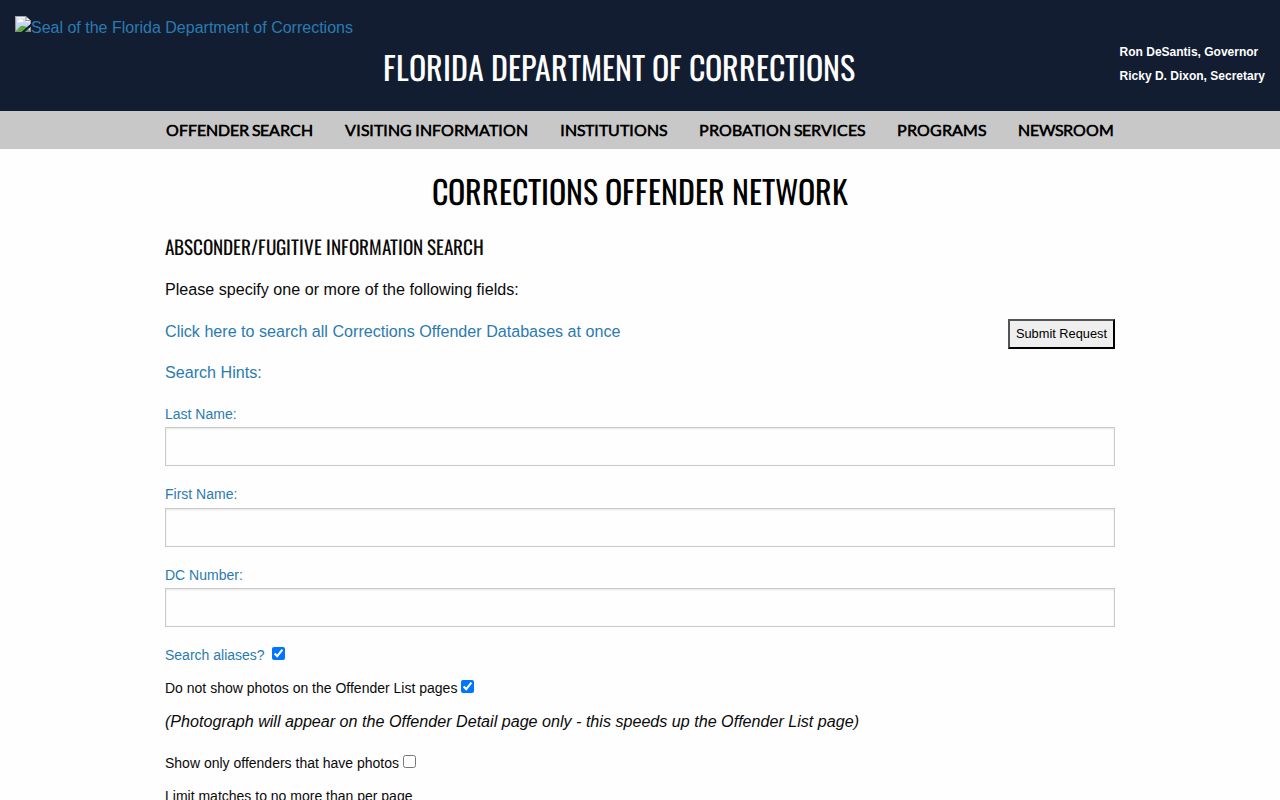
The search is a lead to the applicable FDC and court records, not proof of a new arrest, confinement, or case outcome.
Liberty County Parole Decision Records
Modern Florida sentences generally are not parole eligible. FCOR's official eligibility material describes older offense dates and narrow legacy categories. Therefore, a person leaving Liberty Correctional Institution should not be casually described as paroled. The record may instead show sentence expiration, conditional release, or another lawful mechanism.
The Commission Voting Schedule is a rolling monthly calendar. A linked dated agenda may show a person's name, DC number, county, offense, case, category, and whether a panel or full Commission will act. Yet an agenda entry is not the decision. An interview, review, revocation setting, draft hearing, or effective interview does not by itself mean release was approved.
When the outcome is not visible, request the signed action through FCOR Public Records. Ask for the order, vote sheet, PPRD or EPRD action, revocation order, or supervision order tied to the DC number and case. Requests may be oral and anonymous. FCOR lists fcorlegal@fcor.state.fl.us, (850) 848-4460, and 4070 Esplanade Way, Tallahassee, FL 32399-2450. The office invoices charges before processing but posts no special flat fee.
Note: A Commission agenda identifies a pending matter, while only the signed case action establishes the result for that person.
Liberty County Supervision Violations
Conditions are person-specific. The controlling court or FCOR order is the source, not a general summary. A violation may produce an affidavit, warrant, hearing, modification, revocation, or other action. The public record should be read in sequence so that an accusation is not mistaken for the final decision.
Probation and community-control actions usually lead back to the sentencing court. Parole and conditional-release decisions lead to FCOR, while FDC field staff provide reports and carry out supervision. A willful and substantial violation can lead to revocation under the applicable program, but the exact consequence must come from the signed order.
VINELink can provide custody and supervision-change alerts where the reporting agency offers them, but it is not the violation order. The Liberty County released-inmate search paths explain how to reconcile jail, court, FDC, and federal records when a person's custodian changes.
Ending Liberty County Post-Release Supervision
Supervision ends through an official termination, expiration, discharge, revocation into custody, or another action authorized by the controlling law and order. A date printed on an older search result is not enough if a later case event changed the term. Review the current FDC status and termination date, then confirm the discharge paper when the distinction matters.
For probation, the Liberty Clerk case can contain an order that terminates or modifies supervision. For parole or conditional release, request or review the applicable FCOR action. The FDC detail helps establish whether field supervision remains active and where it is assigned. A prison release record proves the prison episode ended, but does not prove that community supervision also ended on the same day.
A clean verification therefore uses two records: the current operational status and the legal order behind it. That method also accounts for updates that arrive on different schedules. It avoids treating a roster absence, an expired-looking date, or an old hearing agenda as a complete discharge record.