
Liberty County Projected Release Terms
Florida records use several date labels. FDC's public current-inmate detail says Current Release Date. Florida Statutes § 944.275 calls the gain-time projection a tentative release date. Parole law uses presumptive parole release date, or PPRD, and effective parole release date, or EPRD. Those terms must stay separate because they come from different calculations and legal processes.
A scheduled date is forward-looking. Actual release is a completed custody event. For state prison, a past out-custody entry in FDC Inmate Release is stronger evidence that release occurred. For Liberty County Jail, the sheriff's booking and release transaction records the actual event. A transfer from the jail to FDC or from Liberty Correctional Institution to another prison is not release into the community.
- Maximum sentence expiration
- The sentence endpoint before lawful credits adjust the tentative release date.
- Gain-time
- Credit FDC may award under the governing statute, subject to eligibility and forfeiture.
- Detainer
- A request or legal basis for another authority to take or retain custody.
- Jail credit
- Time already spent in county jail that the sentencing court directs be credited.
Find a Liberty County Projected Date
Begin with the last known custodian. Liberty Correctional Institution and Liberty South Unit are FDC state facilities. Liberty County Jail is a sheriff facility that holds pretrial detainees and people serving short local sentences. The same county name on those institutions does not make their release calculations interchangeable.
- Identify whether the person is in Liberty County Jail, an FDC institution, or another system.
- For an active FDC prisoner, open the Current Inmate Population search and use the six-character DC number when available.
- Verify the person by name, birth date, photograph, sentence county, case number, and other identifying fields.
- Read the
Current Release Date, initial receipt date, current facility, sentence history, detainers, and incarceration history together. - If the field says
TO BE SET, do not calculate a substitute. Contact the Bureau of Admission and Release or wait for the agency calculation. - For a county case, obtain the judgment, jail-credit terms, later court orders, and LCSO's current calculation or release transaction.
FDC says current-inmate release dates and location changes update nightly, while other current-inmate data generally refreshes weekly. Release Information updates nightly. Those are database schedules, not a promise that every new order or source document appears at once.
The official FDC example captured in the manifest shows the on-screen Current Release Date and the warning that it remains subject to change.
Review the official FDC current-inmate record format.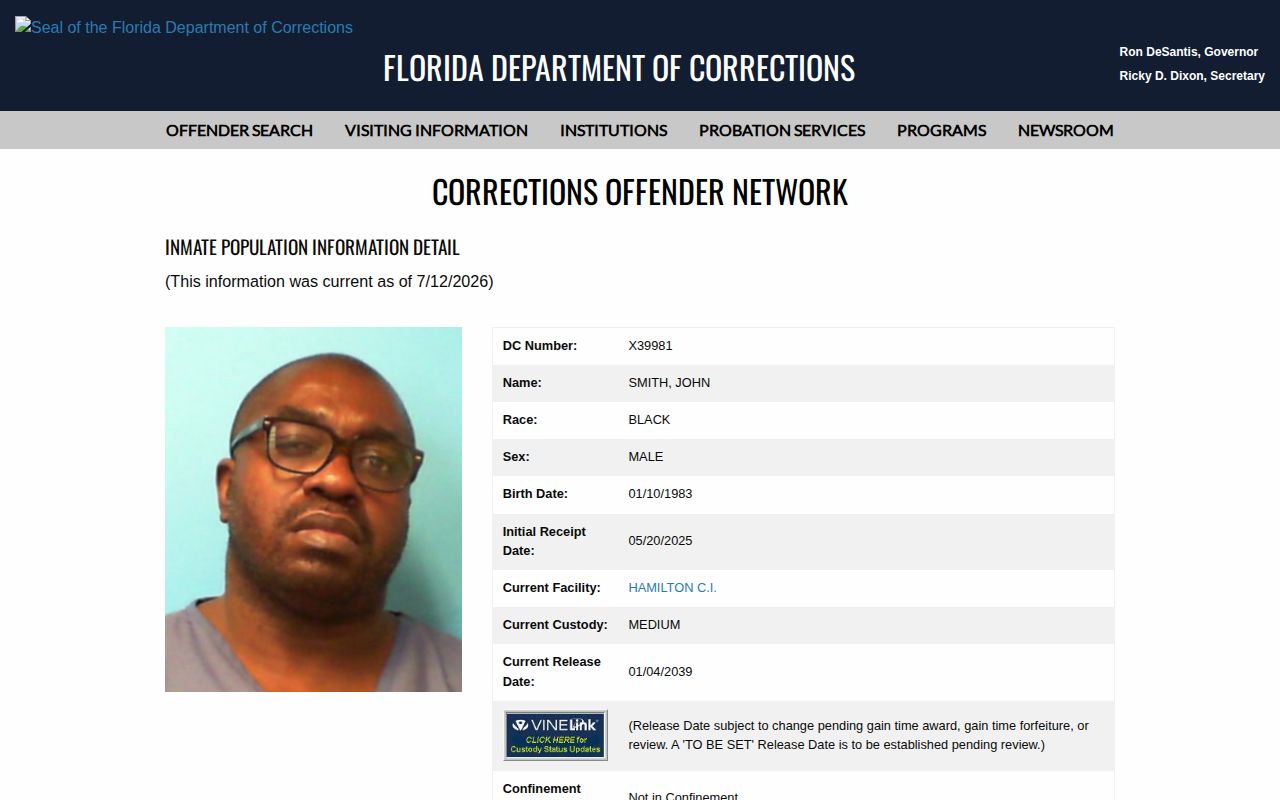
The field must be read with the person's live custody and sentence data, not copied as a guaranteed exit date.
Liberty County Release Date Screen
The FDC screen language creates two common traps. First, Current Release Date is the portal label, while tentative release date is the statutory calculation term. Second, an active record can display TO BE SET while calculation or review is pending. Neither situation authorizes a private estimate.
Confinement Status: Not in Confinement is also not stand-alone release proof. FDC treats it as an internal status, and an active record may show that phrase while also identifying a current facility. Confirm a completed state release through Inmate Release Information and a past out-custody date, or through the FDC Bureau of Admission and Release.
| Screen item | Correct reading |
|---|---|
| Current Release Date | FDC's present public projection, subject to change |
| TO BE SET | The date is not yet available on the public detail |
| Not in Confinement | An internal status that cannot alone prove release |
| Past out-custody date | Evidence that the listed FDC custody episode ended |
| Future Inmate Release date | A scheduled event, not proof of completed release |
Note: Keep a dated copy of any result used for planning because the public record warns that the displayed release date can change.
Florida Prison Release Date Computation
Florida Statutes § 944.275 directs FDC to establish a maximum sentence expiration date from the sentence or combined sentences, reduced by lawful credit. A later sentence can extend the maximum. Time outside custody after escape or parole violation can extend it as allowed by law, along with a new term and subject to applicable credits.
The statute then establishes the tentative release date. Gain-time grants or restoration can move that date earlier. Forfeiture can move it later. The tentative date cannot exceed the maximum sentence expiration date. The calculation belongs to FDC, which has the full sentence, credit, disciplinary, and custody record.
Gain-time eligibility depends heavily on offense date and offense type. Basic gain-time of ten days per month is limited to the older statutory period from July 1, 1978 through December 31, 1993. Incentive gain-time tiers differ for offenses before 1994, the 1994 to 1995 period, and the post-October 1, 1995 tier. The statute says FDC may grant incentive gain-time, so a maximum amount is not automatic. Meritorious and specified education awards have separate rules.
The successful statute image in the manifest shows the governing Florida source for the tentative date and gain-time framework.
Read the official Florida gain-time statute.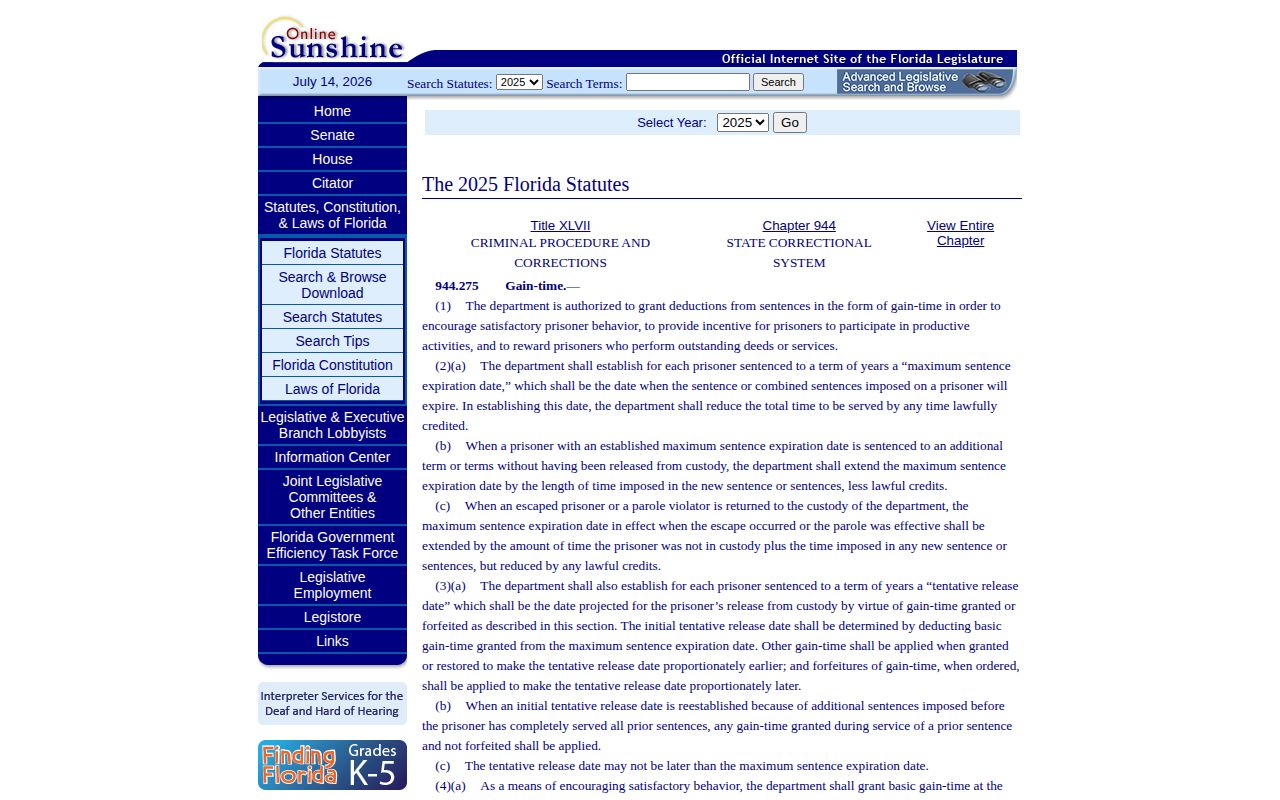
The statutory text explains the framework, but the person's FDC record supplies the agency's current calculation.
Liberty County 85 Percent Rule
The familiar 85-percent rule appears in § 944.275(4)(f). For people subject to the incentive tier for offenses committed on or after October 1, 1995, gain-time cannot produce release before at least 85 percent of the imposed sentence has been served. Court credit for time physically incarcerated counts toward that floor. Gain-time stops accumulating when the tentative date reaches the point at which 85 percent will have been served.
This does not mean every FDC sentence ends at exactly 85 percent. Mandatory minimums, requirements for full service, an added sentence, detainers, amended court orders, credit corrections, eligibility limits, forfeiture, clemency, conditional release, and other lawful mechanisms may affect the date or route out. Life sentences remain natural-life terms absent pardon or clemency.
Discipline can cause gain-time forfeiture under the statute. A later restoration can alter the date again. For that reason, multiplying the sentence by a percentage is not a substitute for FDC's current record.
What Changes Liberty County Release Dates
A projected date can move for more than one reason. Some changes affect the length of the sentence calculation, while others affect where the person goes when one custody episode ends. A detainer, for example, may lead to transfer even if the FDC term reaches its release point.
| Factor | Possible effect | Record to check |
|---|---|---|
| Gain-time award or restoration | May move the tentative date earlier within statutory limits | FDC current detail and calculation |
| Gain-time forfeiture | May move the date later | FDC disciplinary and release calculation records |
| Jail-time credit correction | May change credit applied to the term | Judgment, amended order, and FDC calculation |
| New or consecutive sentence | May extend the maximum expiration date | Court case and FDC sentence history |
| Detainer or hold | May change the destination after one custody episode | Detainer section and receiving-agency record |
| Parole or FCOR action | Uses a separate PPRD/EPRD process where eligible | Signed FCOR action |
| Court amendment | May alter sentence terms or lawful credits | Filed court order and agency update |
A change in facility alone is not release. Liberty C.I. to another FDC prison is a transfer. Liberty County Jail to an FDC reception center begins the state prison path. Always preserve the custody system and destination when describing the event.
Note: A detainer may change where a person goes at release without changing the fact that the first agency ended its custody episode.
Liberty County Jail Release Calculations
Pretrial detainees often have no sentence-based projected release date. Their custody can change after bond, recognizance, dismissal, a court order, transfer, or later sentencing. The court docket may show the legal authority, but LCSO's release transaction shows when the jail carried it out. A bond event is not sentence completion.
For a local sentence, § 921.161 requires the sentencing court to state credit for time spent in county jail before sentence. When the sentence is to FDC, the jail also certifies time between sentencing and delivery. Obtain the judgment and the agency calculation instead of estimating from the arrest date.
County-prisoner good conduct is governed separately by § 951.21. Unless the county commission has discontinued or revised the statutory plan, it allows commutation up to five days per month in years one and two, ten days per month in years three and four, and fifteen days per month from year five. Serious misconduct can cause forfeiture, and qualifying meritorious conduct may support up to five additional days per month on recommendation.
No current Liberty County policy implementing, discontinuing, or revising those terms was located. Do not apply the FDC 85-percent rule mechanically to a short county-jail sentence, and do not calculate a local date from § 951.21 alone. Request the judgment, jail calculation, and completed release transaction.
Liberty County Parole Release Dates
Parole uses its own terms. Under Florida law, an examiner recommends a PPRD for an eligible person and a Commission panel acts on it. Later review and a final interview can lead to an EPRD. A release plan may need approval, and new information can delay action. An interview date or PPRD is not the same as an FDC gain-time date or a guaranteed release day.
Most modern Florida sentences are not parole eligible. The Florida Commission on Offender Review lists older and narrow statutory categories. When a record truly involves parole, use the Commission schedule for discovery and the signed case action for the outcome. FDC's public current release field should not be relabeled as a PPRD.
Conditional release is different again. It is mandatory post-prison supervision for qualifying statutory categories and may follow release from secure custody. The Liberty County probation and parole verification page covers how FDC supervision and FCOR orders establish that status.
Confirm Liberty County Actual Release
Once the projected day arrives, check for a completed record. For state prison, use FDC Inmate Release Information and read the incarceration history for a past out-custody date. Then check Supervised Population because release from prison may start or continue community supervision. If the person remains listed as an active inmate, contact FDC's Bureau of Admission and Release at (850) 488-9167 or dc.release@fdc.myflorida.com.
For Liberty County Jail, call the jail at (850) 756-9749 and request the booking and release transaction through LCSO if needed. Ask for the actual date and time, release reason or authority, and destination or transfer notation. Compare the court docket when a bond, dismissal, sentence, or release order controls the event.
A notification can help with timing, but it remains a separate service. The Liberty County VINELink inmate search explains how to register for offered alerts and why the agency record must still confirm the result.