
Liberty County VINELink Coverage
Florida Statewide VINE is the state's public notification service on VINELink. Official FDC material says the Florida system serves all county jails, FDC inmates, and community-supervision offenders. That supports a Liberty County jail channel, although the sheriff does not publish a separate local VINE participation statement. If a named person cannot be found, use the automated line or contact the likely custodian rather than assuming release.
Coverage stops at important boundaries. VINELink does not cover Bureau of Prisons, U.S. Marshals Service, or ICE records. A transfer from Liberty County Jail to FDC should lead to FDC data. A federal or immigration transfer requires the federal locator or agency record. Liberty Correctional Institution and Liberty South Unit are state facilities, while Liberty County Jail is operated by the sheriff.
| Custody source | VINELink role | Official confirmation |
|---|---|---|
| Liberty County Jail | Latest reported status and offered alerts | LCSO booking and release transaction |
| FDC prison | State custody events and offered alerts | FDC Inmate Release detail and incarceration history |
| FDC supervision | Reported supervision events | FDC Supervised Population detail and controlling order |
| BOP, USMS, or ICE | Not covered | Applicable federal locator, court, or agency record |
Search a Liberty County Inmate
Open the direct Florida VINELink person search. The task is to identify one person, not browse a county release feed. Start with a full name or available offender or record ID. The same name can belong to several people, so compare every identifier and the reporting agency before relying on a status.
- Select Florida and open the person or offender search.
- Enter the person's name or available offender or record ID. Use the exact form shown by the source record.
- Open a possible match and compare identifiers, reporting agency, and the custody system involved.
- Read the current custody status and latest event. Note whether the result comes from the Liberty County Jail, FDC, or another Florida agency.
- If the record says released or out of custody, confirm the date, release method, and destination with LCSO or FDC.
- If no match appears, retry known aliases and contact the likely agency. Do not treat a blank result as proof of release.
The official Florida landing screen in the manifest shows where the state search begins. It is the correct public route for VINE status and notification options.
Open the official Florida VINELink landing page.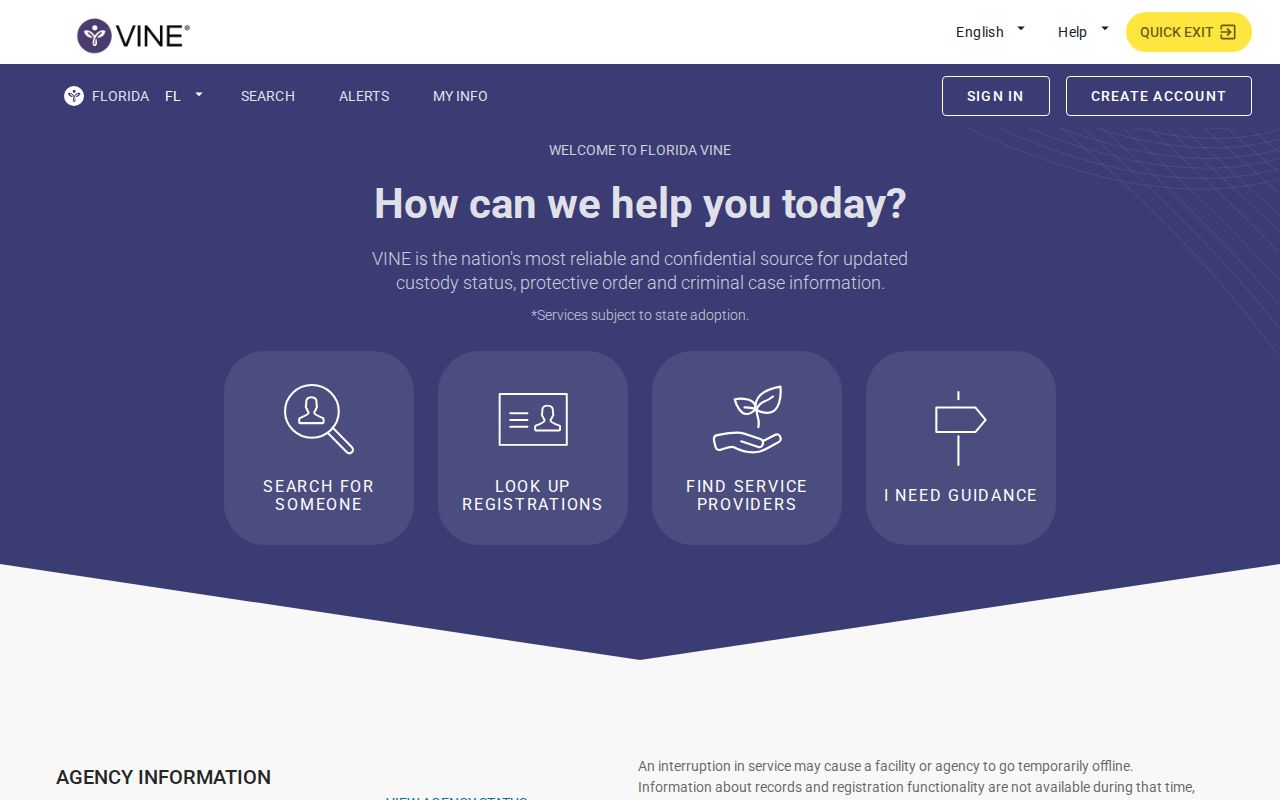
After selecting the record, keep the agency name with any saved status because the agency defines which custody episode the event describes.
Liberty County VINELink Result Fields
Available fields vary by the agency that sends the record. No official source promises that every Liberty County result displays a precise release time, reason, photograph, or lasting history. Read what is actually shown and avoid filling gaps from a different portal.
| Field | What it helps verify |
|---|---|
| Name and record identifier | Whether the displayed person matches the intended subject |
| Reporting agency | Which jail, corrections system, or supervision source supplied the event |
| Custody status | The latest state reported by that agency, such as in custody or out of custody |
| Latest event | The newest release, transfer, or other configured event in the feed |
| Notification options | Which channels and events that particular record permits |
A released or out-of-custody status confirms only that the feeding agency ended its episode. It does not prove a person is free of another county hold, an FDC transfer, a federal or immigration transfer, a court placement, or community supervision. For a sheriff case, obtain the Liberty County release record. For state prison, use FDC Inmate Release and read the out-custody entry.
Note: No official Liberty County rule states how long a released VINELink result remains visible, and live result URLs can depend on a session.
Register Liberty County Release Notifications
Registration begins from a verified person's record. Available phone, text, email, in-app, or TTY channels can differ by agency. The event menu may vary as well. Use direct contact details that the recipient controls, and save the registration information where it can be found when an alert arrives.
- Open the verified Florida record and choose
Get Notifiedor the equivalent control. - Select an offered channel, such as phone, text, email, in-app notice, or TTY.
- Enter a direct phone number or email address and choose the displayed language and event options.
- For automated phone alerts, create a four-digit PIN.
- Review the details and finish the required confirmation or account-verification step.
- When a phone call arrives, enter the four-digit PIN to acknowledge it and stop the repeat cycle.
The phone PIN is not the same as a one-time code sent to verify a text or email account. Email alerts do not use the automated-call acknowledgment sequence. Florida VINE's automated information and registration line is 1-877-846-3435 and operates around the clock. The current national VINELink support number is 1-866-277-7477.
Keep the distinction clear: An alert reports an event from the source agency; it is not the court order or permanent release archive.
Two Liberty County Notification Layers
Florida has a second registration layer through FDC Victim Services. Direct registration in VINELink is not shared with that FDC database. Submitting the FDC form creates or updates a separate entry, even though a direct phone number may be registered for automated VINE calls. This local distinction is easy to miss because both routes can result in VINE contact.
FDC's notification route may cover release, transfer, escape, death, and out-to-court movements. The agency warns that switchboards and call-announcement services can block the automated connection. A direct-dial number is therefore important. FDC Victim Services lists 1-877-884-2846 for weekday help and publishes a mailing address at 501 S. Calhoun Street in Tallahassee.
The successful manifest capture shows the official FDC registration route and its separate agency workflow.
Review the official FDC Victim Notification Request.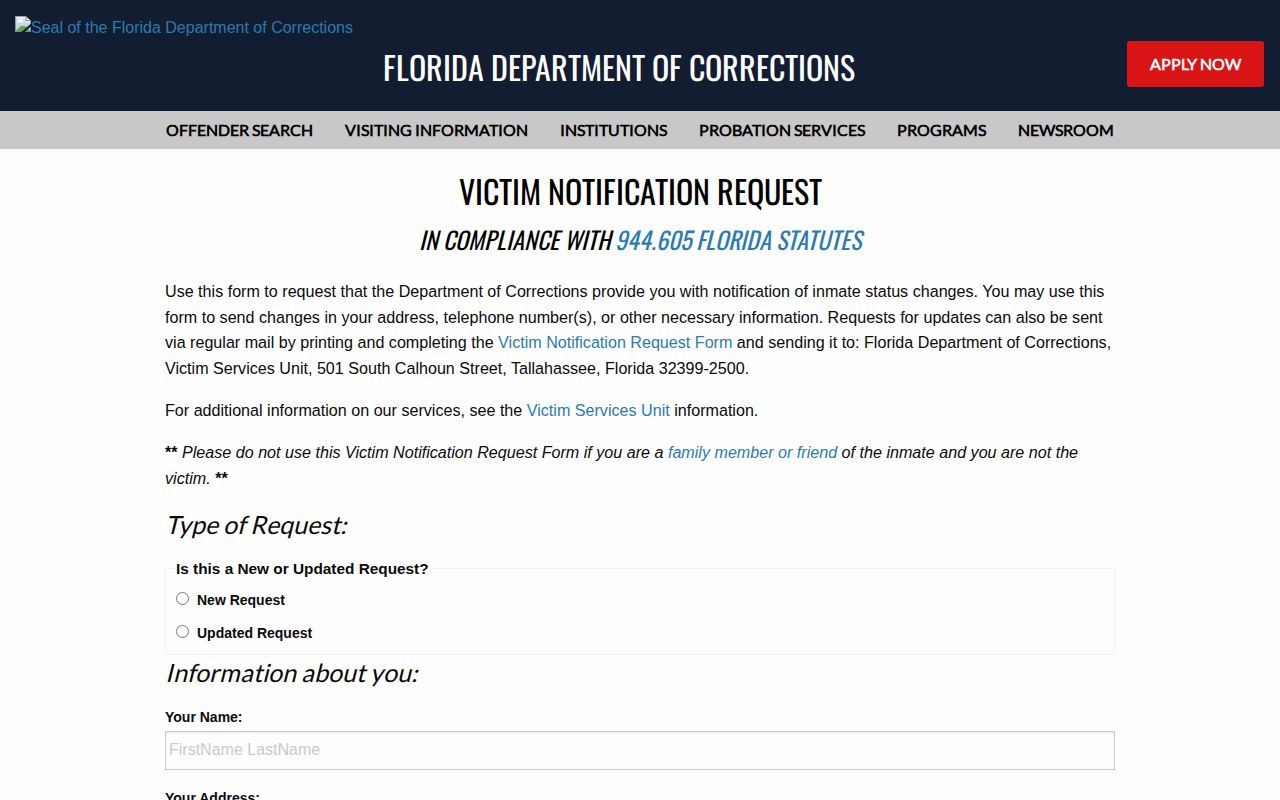
People who need both services must maintain both registrations and keep each contact method current.
Liberty County VINE Versus Registry
Florida's FDLE Sexual Offender and Predator Registry is a separate status system for the limited group that has a statutory registration duty. It is not a substitute for VINELink and does not cover released people in general. A qualifying profile can show a photograph, designation, crime data, registered address, and a legal status such as Released - Subject to Registration, Supervised - FL Dept of Corrections, confined, absconded, deported, civilly committed, or deceased.
FDLE defines its released registration status as no longer under FDC or DJJ confinement or supervision, county-jail confinement, or another court sanction, while still required to register. That can be strong status evidence for a qualifying registrant, but it does not provide the jail's release time or method. VINELink remains the notification route for offered custody events, and the sheriff or FDC remains the source of the completed release transaction.
Use the registry only when the legal registration category applies. A missing registry result says nothing about a person who has no registration duty. The distinction protects against treating a specialized public registry as a general Liberty County released-inmate list.
Note: VINELink and the FDLE registry answer different questions, and neither replaces the originating agency's release record.
Confirm a Liberty County Release
A VINELink status is strongest when it is paired with the source record. If Liberty County Jail supplied the event, ask LCSO for the booking and release transaction, including date, time, reason or authority, transfer destination, and booking number. Compare that transaction with the Liberty Clerk docket because the court record shows the legal authority while the jail record shows when custody changed.
For Liberty Correctional Institution or Liberty South Unit, open FDC Inmate Release Information. A completed incarceration history with an out-custody date documents the end of a state prison episode. A future date is prospective. Then check the Supervised Population search, since release from prison can coexist with active probation, parole, conditional release, or community control.
Identity checks must remain part of that confirmation. A shared name is not enough. Compare an available record number, date of birth, reporting agency, sentence county, and case number before connecting a VINE event to an LCSO or FDC record. If the person was held in Liberty County for Calhoun or Gulf County, the Liberty jail may hold the physical custody transaction while the sending county's court holds the release authority. The agency names explain which record answers each part.
Timing also deserves care. VINE can report a custody change after the source agency transmits it, while an official court order may have been signed earlier. The order states legal authority. The release transaction states when the jail acted. The alert states what the notification feed reported. Keeping those three timestamps distinct prevents an alert time from being described as the actual time a person walked out or transferred.
Where a result identifies a transfer, follow the receiving authority. A person can leave one building without entering the community. The broader Liberty County released-inmate record paths distinguish sheriff, state, court, federal, and immigration channels for that follow-up.
Liberty County VINELink Search Limits
Data can lag. A no-result may reflect a spelling difference, alias, different jurisdiction, unsupported federal custody, feed delay, limited history, or no responsive record. It is not independent proof that the person was released. An out-of-custody event likewise does not exclude a hold, transfer, supervision term, or a later return to custody.
VINELink is designed for status and notice, not as the official release order. It also is not a substitute for an FDC projected date. For a person who is still in state prison, the Liberty County projected release lookup explains the distinct Current Release Date field and why it can change.
A sound check preserves the reporting agency, event date, and person identifiers, then verifies the underlying record. That process is slower than reading one label, but it prevents a county-jail event from being confused with state prison, federal custody, or supervision.