
Liberty County Release Mugshots Are Arrest Records
A booking photograph records appearance during an arrest or jail intake. It is not a photograph of the later release event, and it does not show whether the charge led to conviction, dismissal, transfer, or another result. Release must be confirmed through the jail transaction, court docket, or the corrections system that held the person.
Florida treats a government booking photograph made or received in official business as a public record unless a specific exemption applies. Florida Attorney General Opinion 94-90 concluded that the photograph considered there was not exempt merely because the arrested person was a deputy. Exemptions can still protect particular victim imagery, juvenile material, active investigative information, or other record-specific content.
The Florida Attorney General booking-photo analysis shows how the public-record question is assessed.
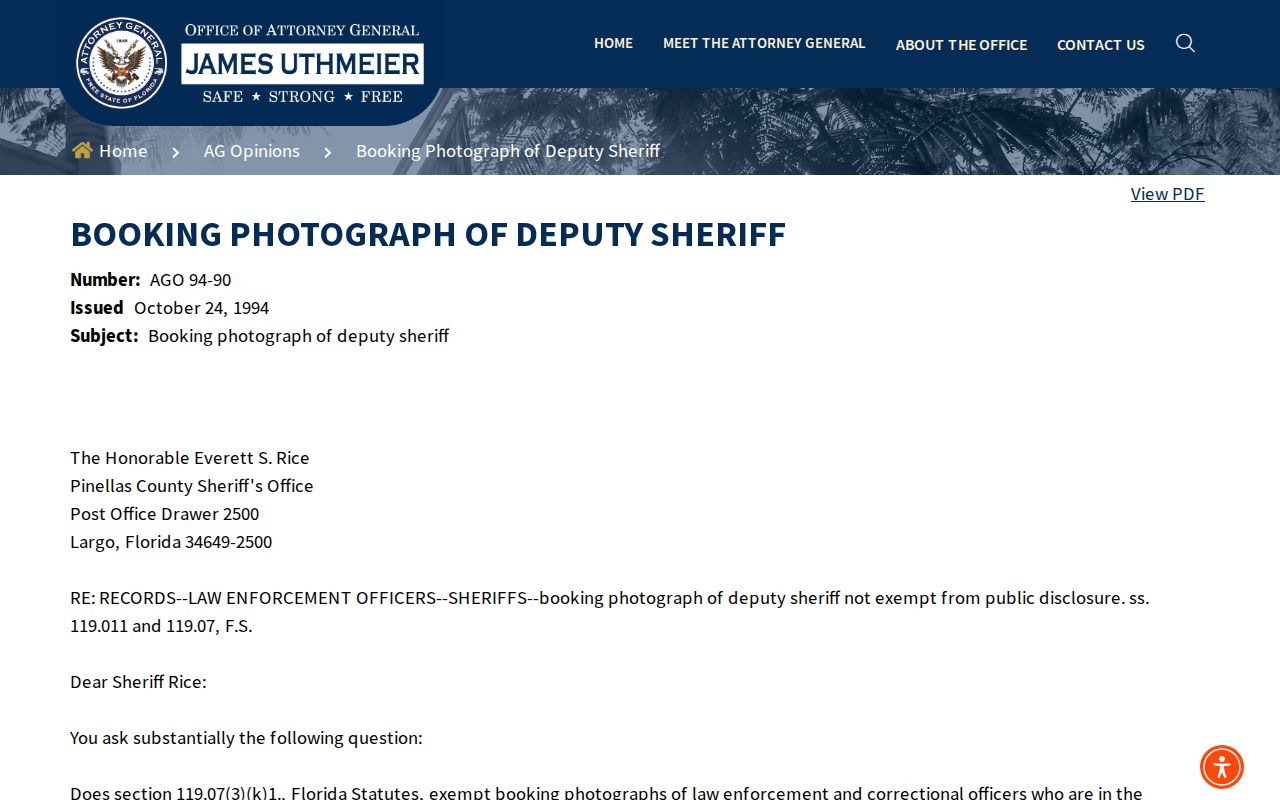
The opinion supports starting from public access while still checking whether a record-specific exemption applies.
The image can remain in a booking file after a released person disappears from a current-custody screen. Website visibility and agency retention are different questions. Liberty County publishes no verified roster or recent-release feed, so no public photo-retention period can be claimed.
Where a Released Liberty County Inmate's Mugshot Appears
Start with the agency tied to the custody episode. A Liberty County Jail photograph and an FDC identification image come from different systems. The FDLE registry has narrower statutory coverage, while a news image may be an old copy with no current status value.
| Channel | Has photo? | How to access and limit |
|---|---|---|
| Liberty sheriff release feed | No verified feed | No official online photo field or retention window was found. |
| LCSO records request | Requestable when maintained and nonexempt | Ask for the electronic booking photograph tied to a booking number, date, and release entry. |
| Sheriff mobile app | No Florida app verified | Do not use similarly named Liberty County apps from Georgia or Texas. |
| FDC Inmate Release detail | Shown when available | Covers state-prison releases, not a Liberty County jail-only episode. |
| FDLE registry | Yes for qualifying registrants | A specialized registry with photographs and legal-status filters, not a general release database. |
| Court file | Possible, not routine | Use mainly for disposition and release authority; an exhibit may contain an image. |
| News or commercial copies | Sometimes | Secondary and possibly stale; no commercial publisher is linked or endorsed. |
A photo helps compare identity only when other identifiers agree. It does not replace the name, date of birth, booking number, case number, or agency information needed to avoid mixing two people.
No Liberty County Mugshot Roster or Sheriff App Was Found
The Liberty County Sheriff's website mentions booking reports, but its current navigation and jail page expose neither a roster nor a recent-release list. The Florida Department of State county-jail directory likewise provides no Liberty inmate-search link. Without a verified interface, there is no supported claim that a release row carries a booking photograph.
The mobile-app sweep found apps for counties named Liberty in other states, not an official Liberty County, Florida sheriff app with jail information. Reusing their inmate data would point to the wrong jurisdiction. The sheriff's official Facebook page is a news and social channel, not a structured booking-photo archive.
The official state directory likewise shows Liberty without a linked inmate search. That missing route makes a direct sheriff records request the primary county-photo channel.
Note: A similarly named app or social post should never be treated as an official Liberty County, Florida booking record.
How to Request a Liberty County Booking Photo
The Liberty County Sheriff's Public Records Division handles arrest reports and accepts online, mail, and phone routes. A precise request should connect the image to the right jail episode and ask for electronic delivery when that format is maintained.
- Gather the full name, booking date or narrow date range, booking number if known, and approximate release date. Add a case number only when it helps identify the episode.
- Open the LCSO public-records portal or contact the custodian. Ask for the releasable electronic booking photograph, booking sheet, and release entry tied to those identifiers.
- State that nonexempt portions may be released separately. If any part is withheld, ask for the cited exemption and a written explanation when needed.
- Review any cost notice before work proceeds. A focused electronic request can reduce duplication and special-service work.
- Compare the photo and identifiers to the release record and court case. Do not infer release date or disposition from the image itself.
Florida section 119.07 requires prompt acknowledgment and a good-faith response, not instant production. LCSO states that timing varies with scope, redaction, backlog, and the records maintained. Florida's default copy rules permit up to 15 cents for a one-sided page, an added 5 cents for two-sided duplication, actual cost for other media, and up to $1 for certification. Extensive work can support a reasonable special-service charge based on actual labor or technology cost.
For help locating the correct jail and case before requesting an image, the Liberty County released-inmate search distinguishes county, state, federal, and immigration records.
FDC Photos for Released Liberty County State Prisoners
FDC's Inmate Release Information Search covers people released from state prison or scheduled for state release. Its released cohort begins October 1, 1997. A detail record can show a photograph when available, along with a DC number, release date, sentence history, incarceration dates, aliases, and detainers.
That photograph is an FDC identification image, not proof that the person had a Liberty County Jail booking. Liberty Correctional Institution and Liberty South Unit belong to the state prison system, while Liberty County Jail belongs to the sheriff. Search by DC number when possible, then compare birth date, sentence county, case number, and incarceration history.
FDC list-page photos can be suppressed while a detail page still offers an image. If the public image is absent or insufficient, request the most recent releasable inmate identification photograph and completed release record through FDC's public-records route.
When FDLE Shows a Liberty County Release Photograph
The FDLE Sexual Offender and Predator Registry can show photographs or flyers for people who have a statutory registration duty. Its detailed search offers status filters that include released, supervised, confined, absconded, deported, and deceased. It is not a general list of everyone released in Liberty County.
The official FDLE registry search provides the released and supervised status controls.
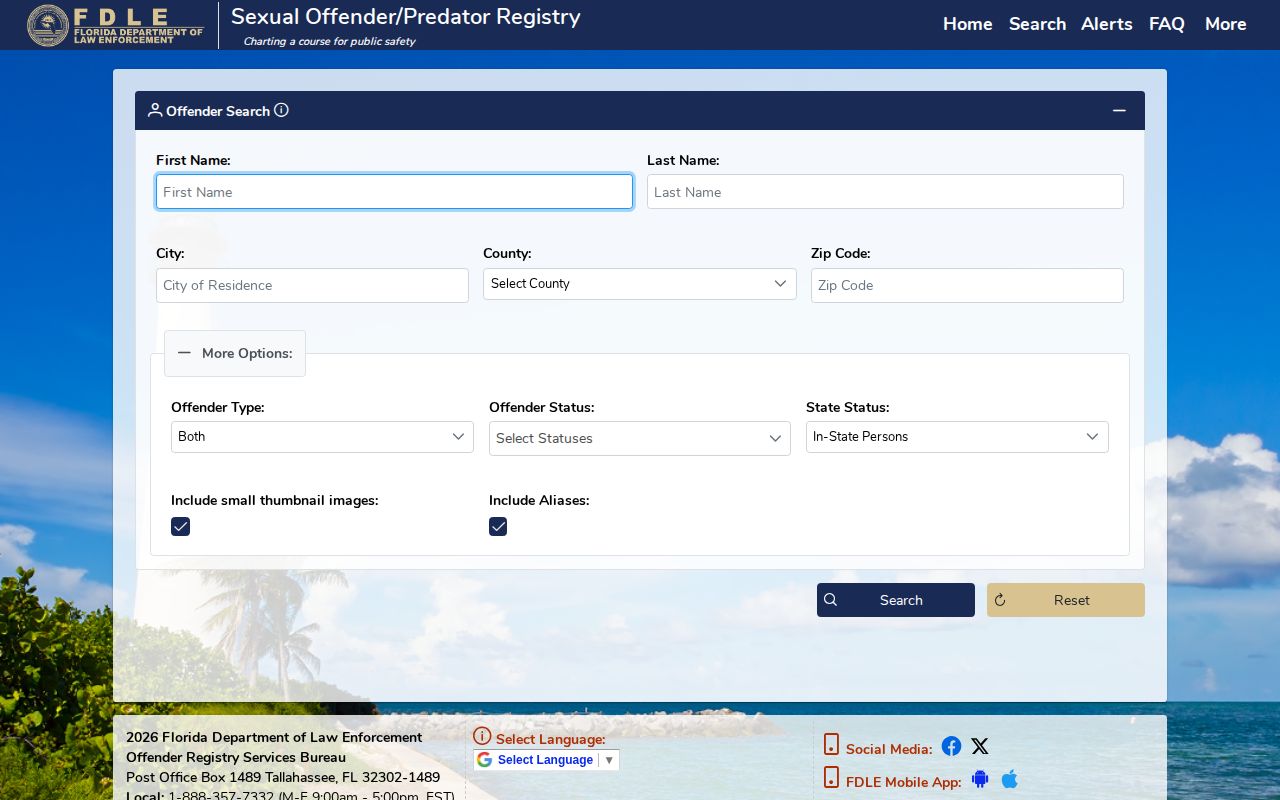
A qualifying profile may connect a photograph with legal status, designation, registered address, and crime information, but it does not supply a general jail release method or exact out time.
FDLE defines a released registration status more narrowly than ordinary out-of-custody language. The person is no longer under specified confinement or supervision while still subject to registration. Verify the current status on the live record because registry data serves a distinct legal purpose.
News and Outside Copies of Liberty County Mugshots
Local news outlets can republish an agency-supplied arrest photograph when reporting a case. Such a photo may help locate the original source, but the article is secondary. An arrest-era image does not establish that custody continued, that charges resulted in conviction, or that the person's appearance remains the same.
Commercial aggregators may also keep copies after an agency page changes. They are described here only as a category because stale or mismatched records are a known discovery issue. No commercial mugshot publisher, data broker, or paid removal service is linked or endorsed. Confirm the underlying booking and release through the sheriff, corrections department, and court.
A court file may contain a photograph as an exhibit, though the Liberty Clerk is not the routine booking-photo source. The docket is more valuable for the bond order, dismissal, judgment, sentence, probation, sealing, expungement, or other disposition that explains the record's legal history.
How Florida Law Treats Liberty County Mugshot Removal
Florida section 901.43 is narrower than a universal right to erase a booking photograph. It applies to a publisher that accepts payment for removing booking photos or whose primary business is commercial booking-photo publication. A covered publisher may not charge for removal.
The photographed person or representative must send a written request by registered mail to the publisher's registered agent, include proof of identity, and identify the specific photo. A covered publisher must remove it without charge within 10 calendar days and may not republish it. The law allows enforcement consequences, but it does not order the sheriff to destroy the source record.
The official text of Florida section 901.43 sets the covered-publisher test and removal process.
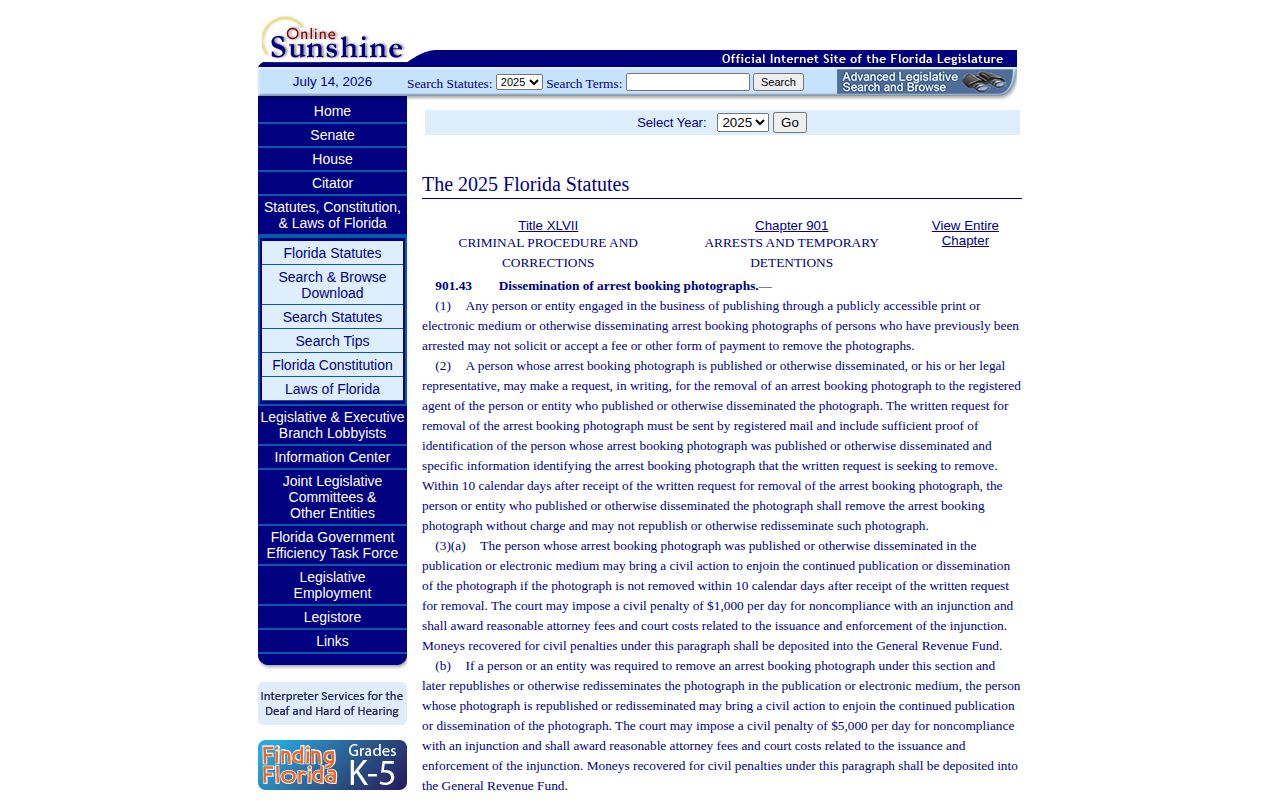
The statute's limited scope is why the original agency record and an outside publisher's copy must be treated separately.
Sealing and Expunging Liberty County Booking Records
Release, acquittal, and dismissal do not automatically seal or expunge an adult record. For ordinary Florida court-ordered relief, an eligible person first applies to FDLE for a Certificate of Eligibility. That certificate does not itself hide the record and does not guarantee that a judge will grant the petition.
A court-ordered seal makes covered records confidential and exempt from ordinary public access. An expunction generally requires covered criminal-justice agencies to destroy or obliterate records while FDLE retains a confidential copy as statute permits. Florida also has an automatic-sealing route for specified qualifying nonconviction records.
These changes can explain why an expected photo no longer appears in an official public result. They do not promise removal of copies already published elsewhere. Eligibility depends on the case and statutes, so the proper sources are FDLE's process guidance, the Liberty Clerk case, and qualified legal advice rather than a generalized assumption based on release status.